
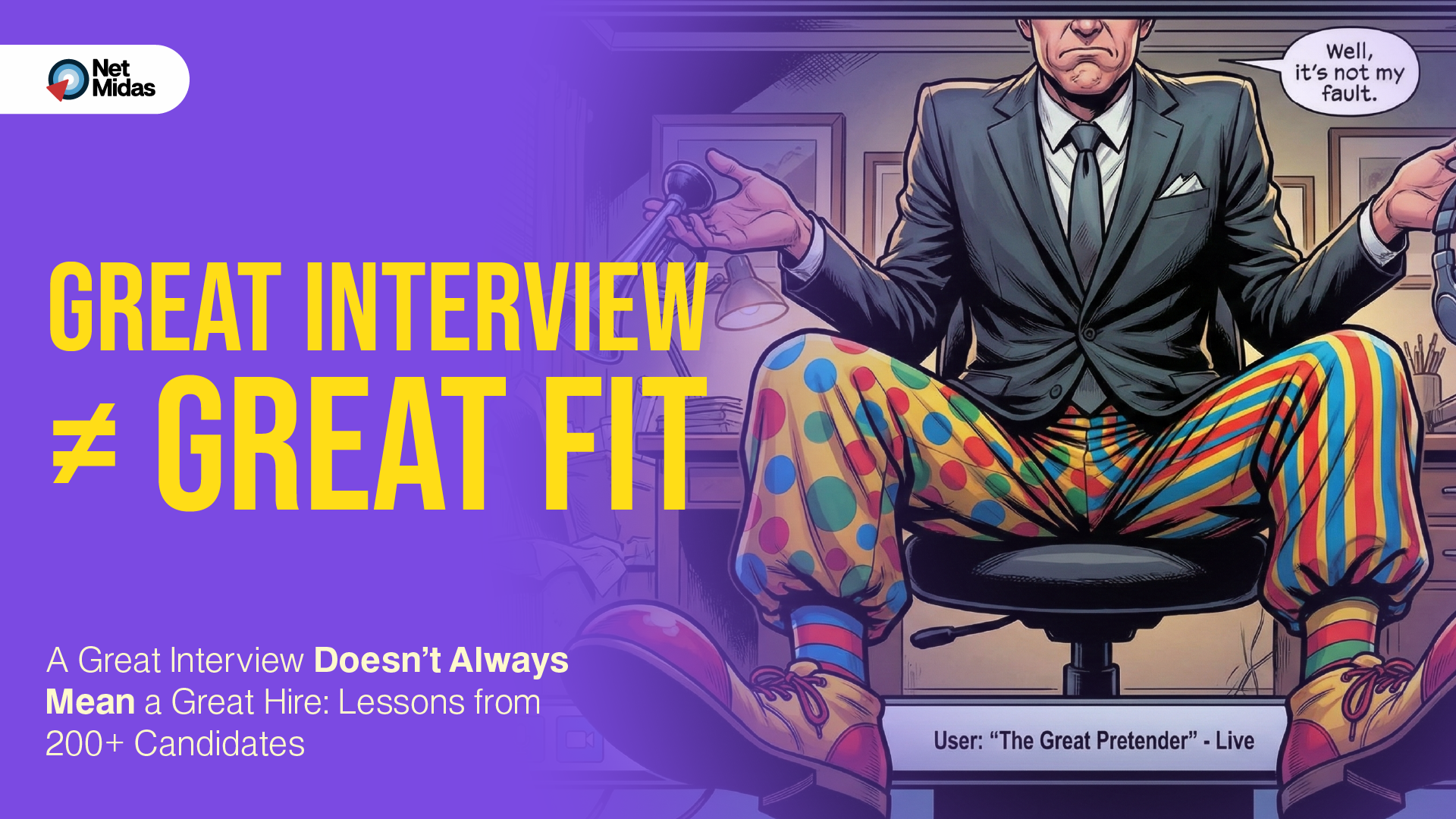
Interview ≠ Fit
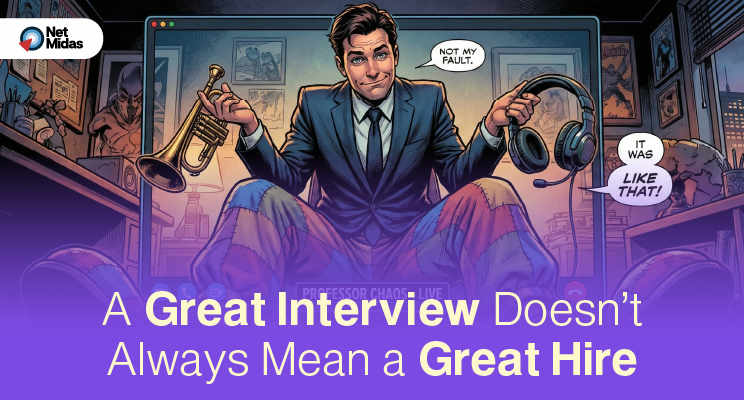
A Great Interview Doesn’t Always Mean a Great Hire: Lessons from 200+ Candidates
A strong interview is not the same as a strong hire.
After evaluating hundreds of candidates across engineering, product, and technical roles, one pattern keeps repeating itself: some of the most compelling interviews don’t translate into long-term performance, while some of the best hires barely shine in conversation.
This disconnect is subtle, but costly.
Teams that over-index on communication skills, confidence, or interview charisma often miss deeper indicators of real-world performance. And in remote, nearshore, and distributed teams, the gap between “interview success” and “on-the-job effectiveness” becomes even more pronounced.
The lesson is simple, but uncomfortable: interviews are the most important signal, not a verdict.
Why Interviews Became the Default Proxy for Fit
Interviews were never designed to predict long-term performance.
They were designed to assess basic alignment, motivation, and communication.
Over time, however, interviews have quietly become the primary decision-making tool in hiring, especially for remote roles where face-to-face interaction is limited.
This happens because interviews are:
- Fast
- Familiar
- Scalable
- Easy to standardize
But they also reward a very specific skill set:
- Verbal fluency
- Confidence under pressure
- Storytelling ability
- Comfort with ambiguity
None of these is inherently bad.
They’re just incomplete.
The Interview–Performance Gap
After reviewing more than 200 candidate processes, a consistent gap emerges between how candidates interview and how they actually perform once hired.
Some common patterns:
- Strong communicators who struggle with execution consistency
- Candidates who interview “by the book” but underperform in ambiguous environments
- Quiet, less polished candidates who outperform expectations once embedded in a team
This gap widens in roles that require:
- Independent decision-making
- Async collaboration
- Problem decomposition
- Long-term ownership rather than short-term output
In other words, many of the skills that matter most don’t surface naturally in interviews.
What Interviews Are Actually Good At (and What They’re Not)
Interviews are good at evaluating:
- Communication clarity
- Motivation and intent
- Cultural alignment at a high level
- Ability to reflect on past experience
Interviews are bad at evaluating:
- Execution under real constraints
- Follow-through over time
- How candidates handle uncertainty
- How they prioritize without guidance
- How they collaborate when no one is watching
Treating interviews as a complete assessment tool is where teams run into trouble.
Signals That Matter More Than a “Great Interview”
High-performing recruitment teams learn to look beyond the conversation.
Some of the strongest indicators of real fit include:
Pattern Consistency
Does the candidate’s past work show repeated evidence of ownership, delivery, and impact—or just isolated success stories?
Decision-Making Clarity
How does the candidate explain why they made certain choices, not just what they did?
Comfort With Ambiguity
Do they freeze without clear instructions, or do they create structure when none exists?
Feedback Integration
How do they respond when challenged or redirected?
Work Artifacts
Code, designs, documents, or systems often reveal more than any verbal explanation ever could.
A Recent Reminder (Pattern, Not Exception)
At the end of Q4 2025, we were reminded, very clearly, why a great interview doesn’t always translate into a great hire.
We hired a professional who, on paper and throughout the interview process, stood out as the strongest candidate in the group.
Technically solid.
Clear communicator.
Highly recommended during evaluation.
For the first few weeks, everything appeared to be going well. Our check-ins showed no obvious red flags, and both the client and the professional seemed aligned.
Then, after roughly three weeks inside the team, the client made the decision to end the contract.
What surprised everyone, including us and the professional, was the reason: the issue wasn’t technical capability or effort. It was an adaptation. Team dynamics. Fit.
Despite being the “best” candidate during interviews, the professional struggled to integrate naturally into the team’s working rhythm and expectations.
We moved quickly to find a replacement.
The outcome was telling: the new professional, who interviewed less impressively on paper, integrated smoothly, aligned better with the team’s dynamics, and is now performing successfully in the role.
This wasn’t a failure of interviewing. It was a reminder of its limits.
And it reinforced a lesson we’ve seen repeatedly: interviews surface potential, but teams reveal fit.
Why This Matters Even More in Nearshore & Remote Teams
In distributed environments, the cost of a mis-hire is amplified:
- Slower feedback loops
- Higher onboarding investment
- Greater dependency on autonomy
- Fewer informal correction mechanisms
A candidate who interviews well but struggles with execution creates friction that compounds quietly over time.
That’s why strong recruiting teams shift from asking:
“Did this candidate interview well?”
to:
“What evidence do we have that this person will perform well after the interview?”
Rethinking “Fit” as an Outcome, Not a First Impression
Fit is not something you confirm in an hour-long conversation.
It’s something you infer through signals, patterns, and evidence.
Interviews should be one input among many:
- Structured evaluations
- Work-based assessments
- Contextual scenario reviews
- Reference patterns
- Behavioral consistency
When interviews are treated as the final filter instead of the starting point, teams dramatically improve hiring outcomes.
Recognizing the limitation of interviews is only useful if it changes how we hire.
A Practical 3-Step System
If interviews alone are insufficient predictors of performance, the answer isn’t to eliminate them - it’s to rebalance the system.
Here’s a simple three-step framework recruitment teams can implement immediately:
Add Evidence
Complement interviews with tangible proof of work. Short, real-world simulations, artifact reviews (code, documentation, deliverables), and contextual problem-solving exercises reveal how candidates think and execute under realistic constraints.
Test Adaptation
Introduce ambiguity on purpose. Ask candidates to react to shifting priorities, incomplete information, or constructive pushback. Performance in dynamic scenarios often predicts long-term success more accurately than polished answers.
Measure Patterns
Look for consistency across roles, decisions, and outcomes. Strong hires show repeated ownership and follow-through over time - not isolated highlights delivered confidently in an interview setting.
The goal isn’t to complicate hiring.
It’s to reduce overreliance on first impressions and increase the weight of observable evidence.
When hiring systems are designed around patterns rather than performance theater, the probability of long-term success increases significantly.
Conclusion
A great interview is a moment.
A great hire is a trajectory.
The best recruitment processes are designed not to reward charisma, but to surface real indicators of long-term performance.
While interviews are and will remain essential, the most critical part of remote hiring, they should never be the sole basis for a hiring decision.



%20Intro.png)


