
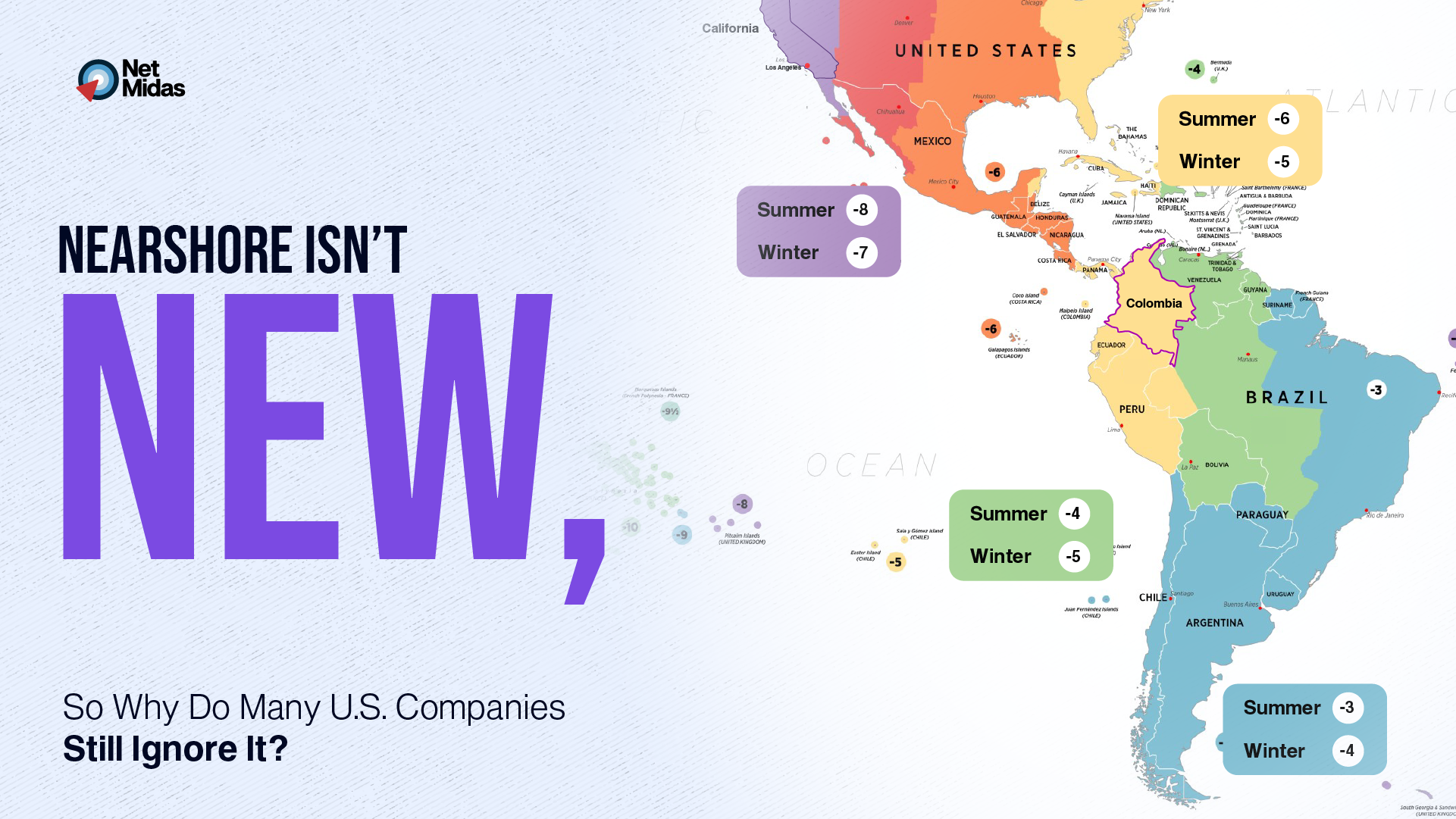
Nearshore Isn’t New, So Why Do Many U.S. Companies Still Ignore It?
Understanding the Awareness Gap Holding Companies Back
Nearshore is not new. It’s not experimental. And it’s definitely not “risky.”
For more than a decade, the world’s biggest and most sophisticated technology companies, Amazon, Google, Microsoft, Intel, JPMorgan, Uber, Oracle, Citi, and over 150 more U.S. brands, have quietly built engineering, product, R&D, cloud, and security teams across Latin America.
And yet, in 2025, many mid-market U.S. tech companies still approach nearshore with hesitation, misconceptions, or outdated assumptions. There is a gap between reality and perception, a psychological, cultural, and informational lag that prevents companies from seeing what’s already obvious:
Nearshore is not a budget hack. It’s a mature, proven, high-performance talent strategy.
This article explores the paradox behind that awareness gap, the cultural narratives that fuel it, and the evidence that nearshore is already mainstream, whether companies realize it or not.
Nearshore Has Been Mainstream for More Than a Decade
Some leaders believe nearshore is a recent trend born out of the pandemic or remote-work revolution. But the truth is far older.
For more than 10 years:
- Google has operated R&D and engineering teams in Brazil (Belo Horizonte).
- Intel has run hardware/software design operations in Guadalajara.
- Cisco, Oracle, Dell, HP, IBM, and others have built substantial engineering hubs in Mexico.
- Citi, Equifax, Western Union, ADP, Fiserv, and other financial giants have maintained tech centers in Costa Rica and México.
- Walmart Global Tech, Uber, Meta, Visa, Mastercard, PayPal, and dozens more have maintained product and engineering footprints in Latin America for years.
This is not outsourcing as it looked in the early 2000s.
This is not offshore.
This is not experimental.
This is long-standing infrastructure, deeply integrated into global engineering and operations.
So why don’t more mid-market companies know it?
Why the Awareness Gap Exists
If nearshore is so established, why is its adoption still uneven across U.S. companies? There are several persistent cultural and market factors:
1. Legacy outsourcing stereotypes
Many leaders still associate “hiring abroad” with outdated offshore models - asynchronous timezones, unstable communication, low-cost/low-quality expectations.
Nearshore is the opposite, but the stereotype lingers.
2. Misunderstanding of Latin America's seniority and capability
There is still a reflexive assumption that Latin America talent means junior or “support-tier.”
This is incorrect.
The region is:
- rich in senior engineers,
- strongly aligned with U.S. engineering culture,
- experienced with agile, cloud, data, and AI, and fluent in English.
But outdated narratives persist.
3. Overemphasis on cost instead of capability
In September, a major U.S. retailer contacted us with a plan to offshore 225 tech roles - offering roughly 30% below the market rate in Latin America. We explained about the risk of churn, we showed them the data on salaries across the region, we shared sample candidates, and even went so far as to remake their business case with real data.
This reflects a widespread misconception:
“Latin America = cheap labor.”
“You can get high-tier engineers for half price.”
“The goal of nearshore is savings above all else.”
But Latin American engineers know their value, especially the good ones.
Underpaying leads to:
- attrition
- instability
- low performance
- wasted time
- reputational damage
In other words:
The problem is not the Latin American market.
The problem is the U.S. perception of it.
This misperception fuels the awareness gap more than any other factor.
4. Lack of visibility
Big corporations rarely advertise the scale of their nearshore teams.
Mid-market companies simply don’t realize the extent of the adoption.
5. Confusion between offshore and nearshore
Companies often conflate Latin America with India or Eastern Europe, despite the massive differences:
- Same or similar time zones
- Cultural alignment
- U.S.-centric work habits
- Communication fluency
- Real-time collaboration
This misunderstanding distorts expectations.
Cost Myths, Market Reality, and Why Underpricing Backfires
The “cheap nearshore” myth is one of the strongest forces keeping U.S. companies from realizing the true value of Latin America.
When companies try to pay significantly below market rates:
- They fail to attract quality talent
- They lose candidates instantly
- Those who do join leave quickly
- Teams become unstable
- Delivery slows down
- Leadership loses faith in the model
This reinforces the false belief:
“Nearshore doesn’t work.”
But it didn’t work because it wasn’t done correctly.
The truth is:
Nearshore works exceptionally well when companies invest in competitive, sustainable compensation relative to local market realities.
Proof That Nearshore Is Already Mainstream
To demonstrate how widespread nearshore truly is, we compiled a high-signal list of 150 well-known U.S. companies with publicly documented software engineering, R&D, or shared-services operations in Latin America.
This list includes Big Tech, Fortune 100 companies, fintech giants, entertainment platforms, cybersecurity leaders, and AI-driven organizations.
Purpose of this list:
To eliminate any doubt that nearshore is a fringe strategy.
It is a mainstream operational model adopted by the biggest and most sophisticated organizations in the world.
A few representative examples:
- Amazon – Mexico, Brazil
- Google – Brazil
- Microsoft – Mexico
- Walmart Global Tech – Mexico
- Uber – Brazil
- IBM – Mexico
- Oracle – Mexico
- Intel – Mexico
- JPMorgan Chase – Colombia
- Citi – Costa Rica
- Equifax – Costa Rica
- NVIDIA – Mexico
- Meta, ServiceNow, Salesforce, Adobe, Atlassian, Datadog, and many more.
Download the Full list here
What this evidence shows:
If nearshore were risky, fragile, or unproven…
None of these companies would rely on it for core engineering work.
What This Means for U.S. Mid-Market Companies
Most mid-market tech companies are not early adopters.
They are late adopters, catching up to a reality that already exists.
Nearshore today is:
- standard
- predictable
cost-efficient (but not “cheap”) - high-skill
- aligned with U.S. work culture
- deeply integrated into global delivery models
Mid-market companies do not need to invent the playbook - they only need to follow it.
The Real Risk Is Not Using Nearshore - It’s Ignoring It
As AI accelerates demand for engineering talent and skilled labor becomes more competitive, companies that ignore nearshore are exposing themselves to:
- longer hiring cycles
- higher salary pressure
- weaker talent pipelines
- slower velocity
- higher burn rates
Meanwhile, competitors who adopt nearshore early gain:
- speed
- flexibility
- cost stabilization
- stronger technical depth
- geographic redundancy
The risk is not in adopting nearshore.
The risk is falling behind.
Conclusion
Nearshore has been a proven strategy for more than a decade.
The world’s top companies rely on it.
The infrastructure is mature.
The talent is world-class.
The operational model is validated.
The only thing missing for many companies is awareness.
Once they see the reality - and let go of outdated cost myths - they discover that Latin America is not an alternative model…It’s the modern model for building resilient, scalable engineering organizations.


